

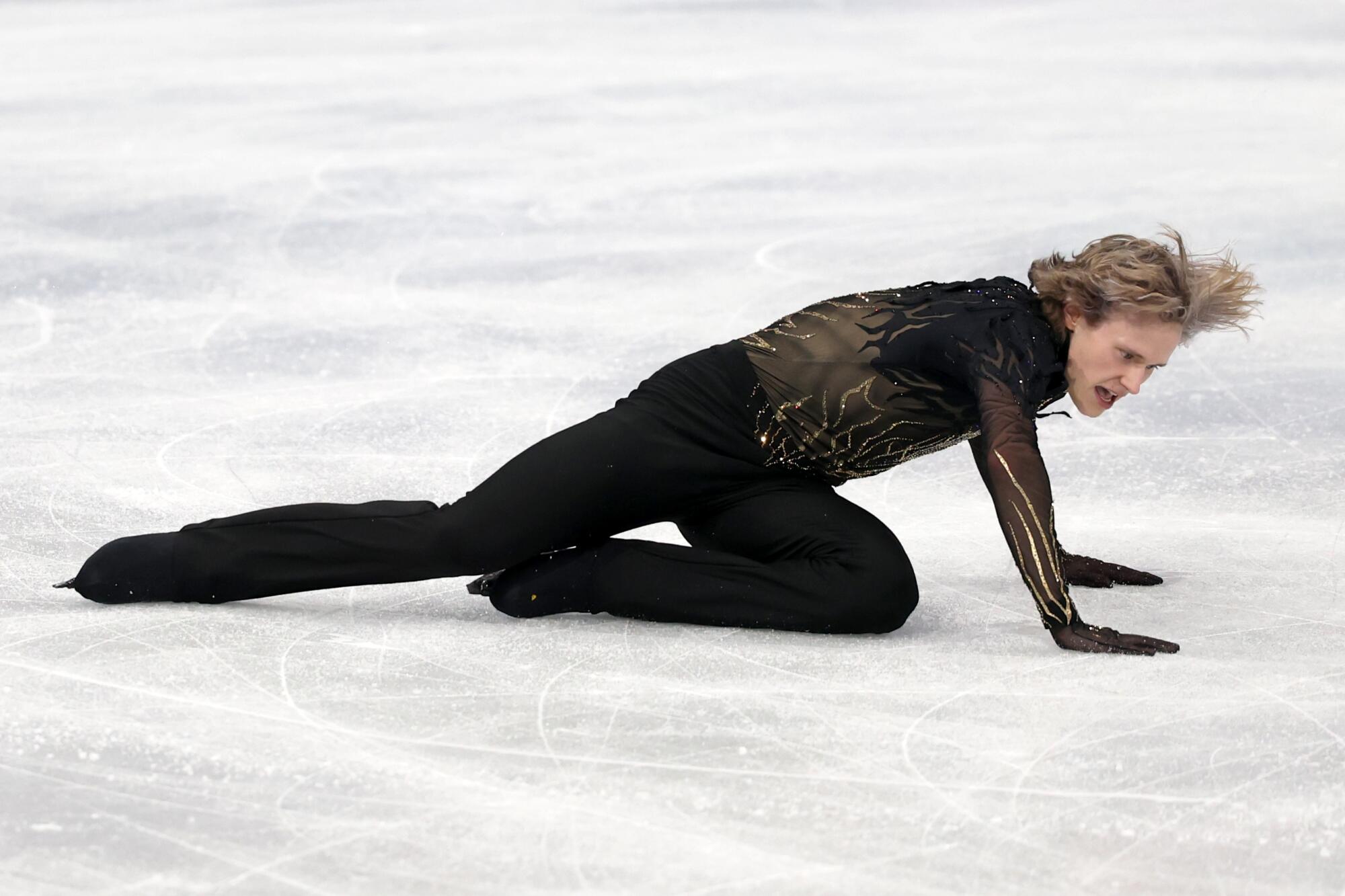
The American skating phenom had a complete collapse in his free program, falling twice and popping multiple jumps — including singling a planned quadruple axel.

As his music finished, the 21-year-old held his hands in his face, appearing distraught and stunned. Malinin, who finished the short program in first with a comfortable five-point lead over Japan’s Yuma Kagiyama, ended up in a shocking eighth.
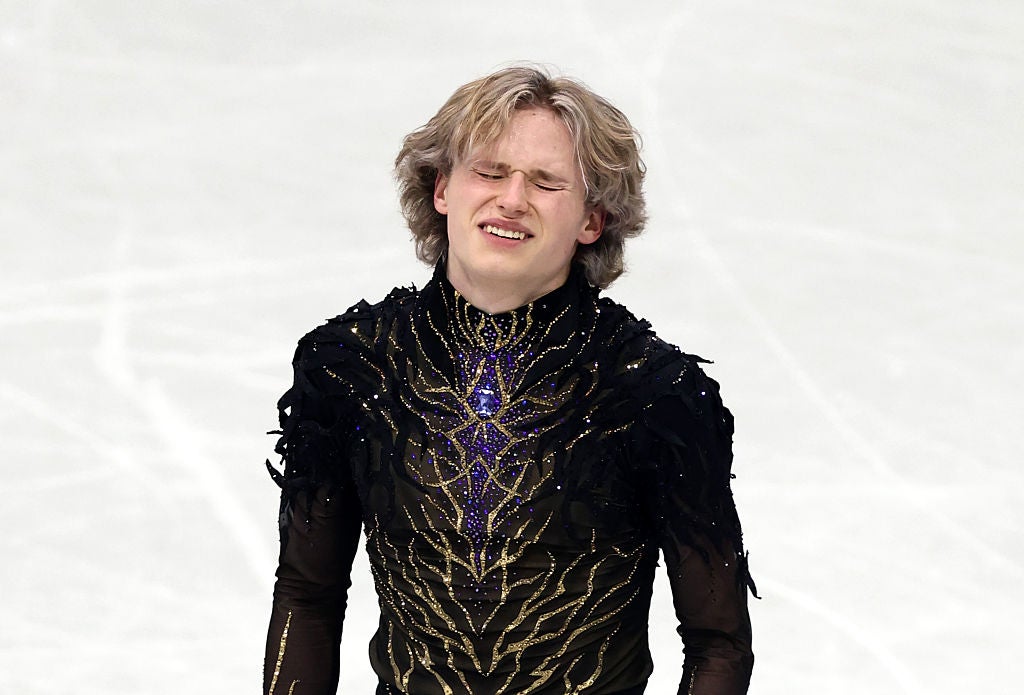
It was the end of two-year plus, 14-competition winning streak for Malinin.
Speaking to reporters after the event, Malinin said that as soon as he hit his starting position, he began to feel overwhelmed.
“All of this pressure, all of the media and just being the Olympic gold hopeful was just a lot — too much to handle,” Malinin said. “It’s not a pleasant feeling and honestly — still — I’m trying to understand what happened specifically. But I know that it’s always – it’s done. I can’t change the outcome.”
Incredibly, Kazakhstan’s Mikhail Shaidorov emerged the Olympic champion on a night when many of the top contenders struggled to stay on their feet. Shaidorov entered the free program in fifth about 15 points behind Malinin, but posted a final score of 291.58. Japan’s Kagiyama and Sato Shun were silver and bronze.

For the figure skating community and Kazakhstan, Shaidorov’s gold medal is especially meaningful, as just eight years ago, Denis Ten — who won the country’s first figure skating medal, a bronze, in 2014 — was stabbed to death in during a car robbery.
Remarkably, Canada’s Stephen Gogolev produced the second-highest free program score of the night with a combined season’s best score of 273.78 — just 1.12 points off the bronze medal.

The 21-year-old Torontonian, who was 10th heading into this final skate, finished in fifth. It was Canada’s best showing in the men’s event since Patrick Chan won silver at the 2014 Sochi Games.
“I think it’s definitely a special moment that I will cherish for the rest of my life. I’m overjoyed with emotions right now,” Gogolev said afterwards.
Friday night’s outcome is one of the most shocking collapses in figure skating history.

Malinin is not just a generational talent, he is regarded as an athlete who is changing the entire sport.
For years, no one thought a quadruple axel was physically possible, but at just 17 years old, Malinin made history by becoming the first skater to land the jump in competition. It’s a feat he’s repeated a number of times in international competition since — including at the last two World Championships, which he won handedly, and at last December’s Grand Prix final, where Malinin became the first skater in history to land seven quads in one program.
Heading into these Olympics, Malinin has faced constant questions about whether he plans to make history by performing the quad axel at the Games.
He left it out of his program in the team event — where Team USA won gold — and in Tuesday’s short program. Afterwards, he told reporters that he would not attempt the jump unless it felt right.
“I’m hoping that I’ll feel good enough to do it,” Malinin said. “But of course I always prioritize health and safety. So I really want to put myself in the right mindset where I’ll feel really confident to go into it.”

On Friday, Malinin started strong with a quadruple flip, but seemed tight in the steps setting up the axel. Malinin popped out of the jump, producing only a single. Things deteriorated afterwards.
The crowd repeatedly gasped as Malinin struggled through each element. Towards the end, even though it was clear that he had fallen completely out of podium contention, the arena erupted in cheers as the crowd acknowledged the superstar athlete’s incredible competitive run.
In the end, Malinin’s free skate ranked 15 of the night. But he still comes away from his first Winter Games an Olympic champion after winning the team event.
“Something felt off. I don’t know what it was specifically. I’m still trying to understand,” he said.